






Most organisations are not short of data, insight or decks. Their biggest challenge is not whether customer understanding exists since most teams have access to more customer insight than ever before. The challenge is whether customer understanding is visible, memorable, trusted, used early enough, and influential when decisions are being made.
That’s where Customer Salience comes in. At FlexMR, we use Customer Salience to describe the role customer understanding plays inside the organisation: whether it is front of mind, actively considered, and able to shape business decisions. It’s all about ensuring the hard work we put into customer understanding influences effective decision-making within businesses.
The goal is to move from thinking of insight only as a research output – think project after project without change – to embedding customer understanding within the decision-making culture of a business.
I am a huge proponent of workshops. In the current world of remote working and AI led-insights, there’s significant power in carving out time to get the right people in the same room together – preferably in-person, but online works too.
Workshops can be the key to unlocking Customer Salience capacity. However, they need to be well-designed to create tangible outcomes. After a good workshop, people leave feeling energised and thought-provoked. After a great workshop? People leave with alignment, ownership, direction, confidence, with practical next steps.
This article focuses on two complementary workshop formats which follow that blueprint:
- The Future State Insight Workshops
- The Customer Salience Masterclass
One diagnoses the system. The other activates stakeholders. Together, they help build the conditions for customer understanding to have more impact in decision-making.
However, workshops are only one part of building a stronger insight culture. Their real value comes when the ideas, priorities and commitments generated in the room are carried forward into everyday ways of working. That's where Insight Beacons come in. They provide a simple, practical approach to keeping customer understanding visible long after the workshop ends.
Workshop #1: Future State of Insights
The Future State Insight Workshops take place across two separate sessions: one to diagnose and one to create action.
Session 1: Diagnostic understanding and building a blueprint next steps.
The purpose of this session is to help insight, strategy and marketing teams step back from their day-to-day and reflect on how customer understanding currently works in the business – identifying where it gets stuck, what really gets used and what doesn’t. It looks at the business’s decision-makers and assesses their needs to understand where customer understanding can have the greatest influence.
The framing is: “How do we improve customer-centred decision-making?”
The workshop explores the current state of insight within the business, the desired future state of insight, and how insight is commissioned and communicated: how do the findings flow, where are they needed more, and what decisions are currently being made without enough customer evidence?
In practice, this might include a mix of facilitated discussion, independent note-taking reflection and ‘sharing back’, current-state mapping, and scoring. Teams might be asked to map how insight currently travels through the organisation, identify moments where customer understanding loses influence, and prioritise the decisions where customer evidence could have the greatest impact. The session is structured around diagnosis, challenge, and practical prioritisation.
It’s building the blueprint on how a team moves from a project-led insight team, to a programme-led system of influence.
Session 2: taking the diagnostic, and applying action – the next steps
This session can take different forms. It could be a stakeholder mapping and action plan. It could be building an insight communication plan. It could be both! The focus of this step is taking the learnings from the first session and making them tangible. Outputs should be focused and practical:
- Clear next steps
- Stakeholder mapping
- Ownership model
- Insight activation sprints
- Insight communication plan
This could be a series of programmes identified to have the biggest impact on decision making. For example, a customer closeness programme, a decision-maker community, or an insight communication package. This is where structured support can help teams move from ambition to action, which is an area of support we offer at FlexMR – support to build the tools, rhythms and ownership needed to make customer understanding more influential.
“The sessions struck a balance between reflection and action, helping us to step back from day-to-day pressures and think more strategically about where we wanted to go.
Their support has gone beyond facilitation alone […] helping us think through how to best prioritise and implement the recommendations […] and eliminate the guesswork in customer decision-making.”
Hannah Hartrey, Head Customer Strategy and Insight at Aldermore Bank
Workshop #2: Customer Salience Masterclass
This workshop is about driving a change in decision-making culture with stakeholders. The Customer Salience Masterclass is best for when stakeholder buy-in could be stronger. There’s a need for customer thinking to become more visible in everyday decisions. The data and insight is there, it’s just not reaching its full potential.
Where the Future State Insight Workshops focus on the systems to facilitate effective insight activation, the Customer Salience Masterclass focuses on stakeholder behaviour. It brings decision-makers into the room and helps them explore how customer understanding can be applied in their own roles, priorities, and decision-making. The session is built around FlexMR’s 4C framework:
- Challenge – Explore the current customer frame of reference for your area of business. What assumptions are being made? What is working? What is missing?
- Create – Share ideas on how to raise awareness of the customer and ensure customer understanding has an ongoing impact.
- Connect – Identify the gaps that exist between teams where customer insight could be shared and strengthened. What are the gaps that may require more strategic solutions?
- Collaborate – Get commitment on the identified opportunities to use insight in a more cross-functional way and identify ways in which insight can support more collaboration by understanding needs and constraints.
The mechanics of the session are important. It is not simply a presentation about why insight matters. The masterclass uses the 4C framework as a practical structure for a series of mini-activities and discussions. Stakeholders identify where customer understanding currently shows up, where it is missing, and what small changes could help them bring customer thinking into their own decision-making more consistently.
Stakeholders should leave the session with a buzz, but also with practical ways to act. The goal is changing how customer understanding shows up in decision-making.
“FlexMR delivered a highly effective workshop that helped our senior Service Delivery colleagues see how insight can drive better decision-making and gain prominence in their work.” - Land Registry
The Role of Insight Beacons
Workshops can create energy, alignment and ownership, but the real test is what happens afterwards. This is where Insight Beacons come in – a low-effect, high-cadence customer signal, designed to keep customer understanding visible.
Insight Beacons are small, regular, memorable prompts that keep customers visible in the business. To help remove the theory, here are some easy examples: short insight newsletters, two-minute customer highlight videos, ten-minute ‘lunch and learn’ sessions, in-office activations such as posters in unexpected places, TV screen content, quotes in the kitchen etc.
The point is not to create more noise; it’s not overloading stakeholders with constant content – it’s creating the point to find the Customer Salience sweet spot. That sweet spot is all about finding the balance between effort and frequency.
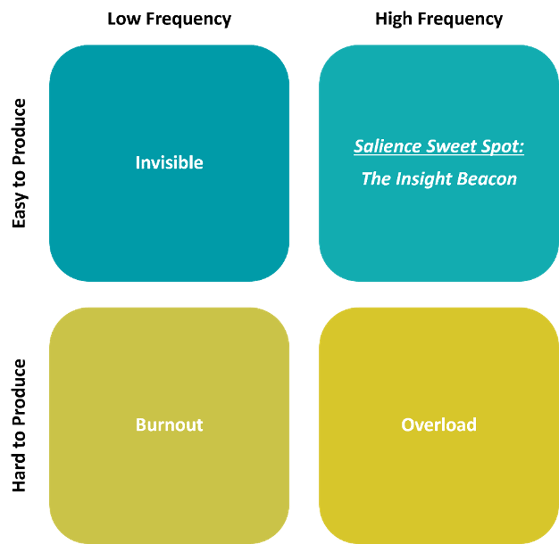
Insight Beacons can help turn workshop momentum into something more repeatable and sustainable. They should be regular enough to stay visible, but light enough effort to be sustainable. Relevant enough to impact decision-making and practical enough that teams can maintain them.
So, whilst workshops are a great way to build alignment, Insight Beacons help to operationalise the culture change that’s needed to embed Customer Salience within an organisation – ensuring customer understanding is driving decision-making.
A Programme of Change
Together, these workshops help organisations to build Customer Salience capacity from two different angles. The Future State Insight workshops diagnose the system: how customer understanding currently flows through the business, where it gets stuck, and what needs to change. The Customer Salience Masterclass focuses on behaviour: helping stakeholders see the value of insight and apply customer thinking to their own decisions.
Neither workshop is the answer by itself. Their value lies in the momentum, alignment and ownership they create – and in how that energy is operationalised afterwards. This is where Insight Beacons play a critical role, turning workshop outputs into regular, visible reminders that keep customers front of mind without overwhelming teams.
The ultimate goal is for customer understanding to become more visible, influential and useful at the point decisions are made. That’s what Customer Salience is all about – helping organisations move from insight as outputs to better customer-centred action.



.png)