






The Customer Salience Summit 2025 started with FlexMR's CEO Paul Hudson saying that insight experts need to "challenge everything we do in our everyday work" if we are to have a chance at affecting change and embedding Customer Salience into any organisation.
A statement which was followed by a roster of fantastic industry leaders all showcasing their experiences and learnings from their strategies; their changes and the way they've challenged the processes they encountered in their organisation to connect their stakeholders to their customers and embed Customer Salience throughout the business. So, let's dive in and see what we learnt.
Leading by Example
The best ways to discover how we can become more Customer Salient, is to learn by example. We had a few case study presentations at the summit, including Yuliia Krupenko, ex-marketing lead at Waggel, Ellie Osborne from Saga, and Jane Callingham, who is the Director of Brand at the BBC.
Yuliia took the time to explore how Customer Salience can be embedded at start-up and scale-up businesses. She concisely defined customer drift by comparing it to a New Year's Resolution: "We take our notebooks and write things we’d like to accomplish in the next year. We stick with it for a month or two, but at some point we get distracted. We focus on other things. Companies drift in the same way. They base decisions on how customers behave, but at some point the customer takes the back seat.” Her modus operandi of 'momentum always beats perfection' has kept business management close to customers as their companies grow and evolve.
Nicola Stevens along with Ellie Osborne at Saga showcased how Saga use their InsightHub platform to closely connect with their customers, generate better quality insights, and use those insights to influence decisions at every level of the business. Ellie said that “we found that a lot of our insights were siloed. Our insights weren’t gaining the traction they needed within the business. Our simple starting solution was a monthly email update, sharing what we were learning about our customers, the research we were doing and truly engage our stakeholders in what we were doing.”
Jane Callingham shared the frameworks that the BBC use to better understand the content consumption habits of their audience, and their audience's relationship to what they do. Jane shared two specific frameworks that she uses: the 'Threshold of Customer Value' framework, which shows stakeholders how long and how frequently their audience watches BBC content, and the BBC Audience Map that reveals how their audience's values and background relates to the BBC. Jane also shared that all of their data and insights are freely accessible to all who work within the company, so that their insights permeate throughout the entire organisation to affect change.
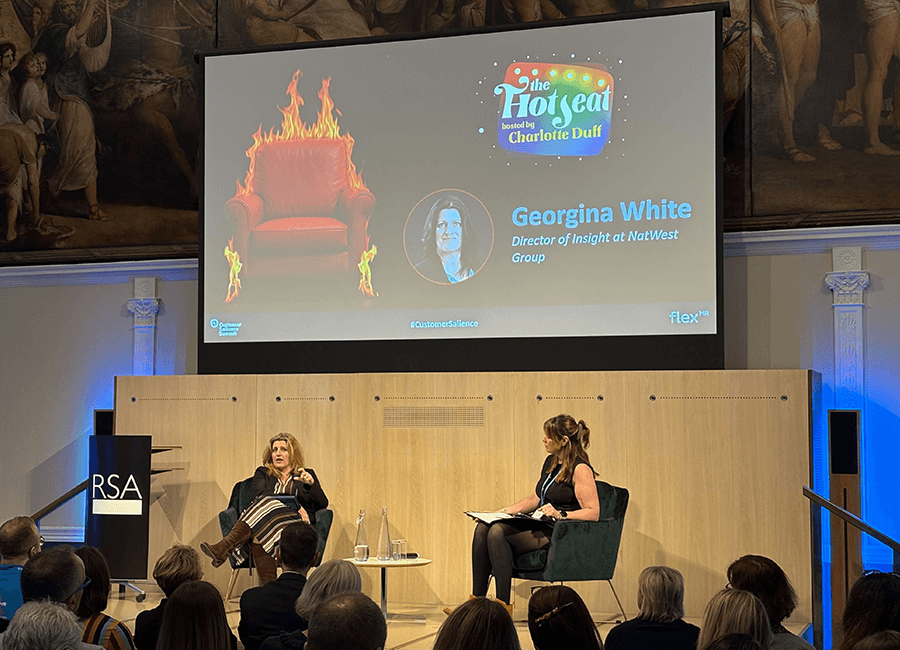
FlexMR's Charlotte Duff hosted a talk-show style panel, where panellists talked about leading by example and learning from failure. James Sallows of the Lego Group believes that there is a general failure in the insights industry to adapt to client needs and ability to challenge client briefs. He advocates that we need to truly understand what clients and stakeholders are truly interested in - that the question they are asking might not actually lead us to the insights they actually need. Once we have this down, we can then ask: just how far can we make our work travel throughout an organisation?
Charlotte then talked to Georgina White of the NatWest Group, who said that one of her failings early in her career was being too scared and talking about the wrong things. That we need to stop being scared, be more assertive and talk more about strategy, customer influence and how we can drive change rather than methodology and stories. Georgina also talked about how we should never underestimate the power of politics and leveraging cultural dynamics within an organisation; making allies of stakeholders before having the tough conversations will make them more receptive... or at least won't leave them walking out of debriefs before the end.
Practical Measures & Takeaways
Dr Alan Gilchrist of Lancaster University Management School started his talk by saying, “For years we’ve not been at the top table. Thanks to advances in technology, and research, and insights, you’ve put us at the top table. But that then still doesn’t translate to the strategic decision making in the organisation.” Understanding where it's going wrong is the key factor to helping overcome it. And sometimes, the challenge comes from taking into account everyone's views; in every organisation there is a view from somewhere: product-centric, customer-centric, business-centric, etc. how do we get them all around the table?
Iosetta Santini from Keen as Mustard Marketing hosted a fierce 'Pitch Battle' panel, with panellists: Rupesh Patel of Samsung Electronics, Clare Woodward of BT, Liz Boffey of Sainsbury's, Guillermo Fernandez of eBay, and Becci Toone of the Stars Group. These five competitors pitched the one thing they believed that we can do today to engage stakeholders in customer insights:
- Becci Toone proposes that the number one thing should be to reframe insights through a financial lens. We know when stakeholders engage with insights, outcomes improve. It turns insight into a business case and makes insight indispensable.
- Guillermo Fernandez pitches that we need to reposition the insights function as a coach and guide. Use training and preparation to increase data, knowledge and insights. The game plan is building a narrative stakeholders can retail. With the right coaching, we can outprepare and outperform the competition.
- Rupesh Patel argues that we need to add video into the insight value chain. Short, sharp, and to the point videos with a teaser beforehand builds excitement and creates engagement with increased insights activation. The big challenge is: are insight experts willing to get on camera themselves to help deliver insights?
- Clare Woodward says that we need to build knowledge bases with a searchable front door that stakeholders can use in the place of ChatGPT. Studies bring such rich context and facts and trump the guesswork of AI models. We need to be as easy to access as the app in their pocket to make ourselves indispensable.
- Liz Boffey closes the debate by sharing that she thinks we need to drive confidence and belief through being reframed as the business friend and partner, not just service providers. We are the art of engagement, influencers, catalysts and guides in business. We have the opportunity to drive change, embedded in our key skills of being great communicators and storytellers.
Charlotte Vicary of the Customer Closeness Company aimed to provide attendees with key strategic tactics to embed in their own Customer Salience Strategies, and arguably the most important one is identifying exactly what helps us become visible in a company - what are the most common reasons that get us into the boardroom and key conversations? Here are four of the most common reasons that emerged:
1. When stakeholders believe that their business will be a success when better connected to customers . Strong customer instinct helps us to make better decisions.
2. When people need to unstick the stuck - when stakeholders feel the need to galvanise action with an injection of customer reality.
3. Regulator pressure can help us enter the right conversations. For example, Consumer Duty, where the board need to demonstrate that they’re looking at customer outcomes.
4. A need to build a common understanding and vision internally. If there has been a lot of change within an organisation, like a new leadership team or a spate of new hires across other areas of the business, values and customer connection can easily get lost.
Judy Taylor of ConsultJMT led another workshop centred on understanding how customers respond to the language we use and the messages we present. She showed us how to use narrative modelling and process design techniques to develop programmes of transformation with purpose and value. She started the session by pointing out that we need to stop thinking about customers in terms of purchase and engagement, and more about how we can excite them, surprise and delight them. Only then can we form full relationships with the people we want to serve.
Jane Frost, CEO at MRS, spoke first about building alliances with key stakeholders; a sentiment expressed again in by Georgina White in the later panel session. Jane said that, “We need to build alliances with key stakeholders. Building relationships will help people understand what the desired outcomes are, not just outputs. With this outcome, comes value. It may well be surprising and changes your relationship with the customer.”
Jane went on to discuss the state of AI and ownership in the insights industry, “the insights sector missed a real trick on GDPR – we could have owned customer privacy. We didn’t...We ought to be owning the quality issues that go into AI. The fact that nobody knows what the data is that is going in, and nobody knows what is coming out. Smoke and mirrors is what you are being sold."
What Will You Do Now?
Paul Hudson closed the event with one simple question - after everything we have talked about today, what will you do next?
Each attendee received a pledge card and was asked to pledge to one thing they wanted to enact towards their Customer Salience strategy after they left the summit. It is incredibly encouraging to say that we received every single card back, each with a different action they were going to take once they got back to their offices the next morning. For the most part, there was a lot of chatter around starting small and then building up; placing that first brick rather than trying to construct the entire wall at once.
This year's summit was a fount of inspiring discussion, fascinating insights and a mountain of practical case studies and actions for our attendees to apply in their own strategies to better connect decision-makers to customers.
If you missed your chance to attend the 2025 Customer Salience Summit and want to glean some of these insights and actions for yourself, make sure to catch the summit on-demand now.